Email that lands, and an inbox that tells you what happened.
Email Digit sends your marketing email and your app's email, and manages the authentication that decides whether either one arrives. Every reply that comes back is read, sorted and scored — so you find out what your email actually did, not how many pixels loaded.
Start free: no card. There's nothing to cancel.
Domain check: free, no account. We'll tell you what's broken in your SPF, DKIM and DMARC.
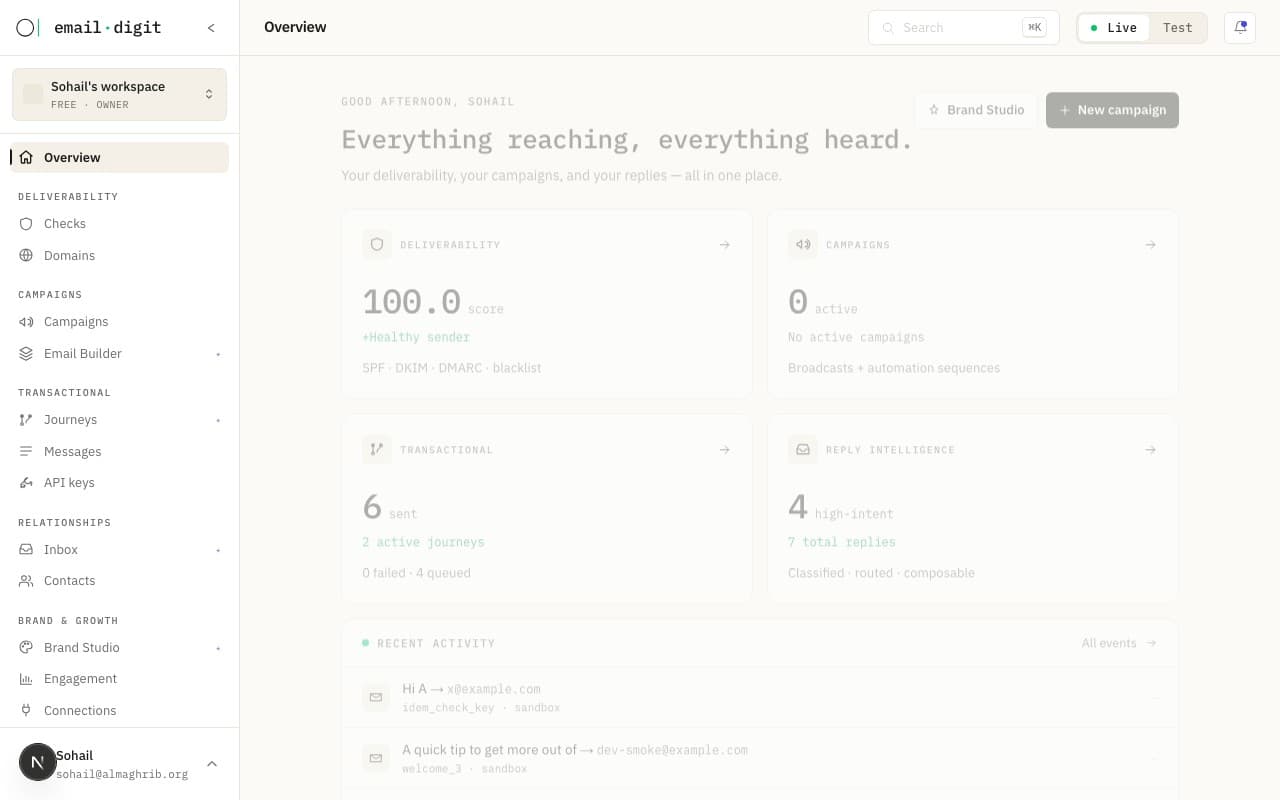
Two products. Pick the one that's yours.
They share the same sending stack, the same contacts and the same inbox. They look nothing alike, because you don't. Choose at signup; switch any time.
I send campaigns to a list.
Broadcasts, automations, segments, and an editor that writes on your brand. Contacts are never counted or charged for. Your report leads with replies and revenue instead of open rates.
See the marketing product →I send email from my app.
Password resets, receipts, onboarding sequences. Define the email once, then fire a trigger with one authenticated POST. Test keys sandbox everything. Every send is searchable.
See the developer product →Not sure? Start as a marketer. Nothing is locked, and the other product is one click away in the sidebar.
You bought a builder.
You needed infrastructure.
Most email tools are excellent at the part you can see and indifferent to the part that decides everything. Drag-and-drop is solved. Authentication is not.
Gmail and Yahoo have required DMARC from bulk senders since 2024. Microsoft finished enforcing the same rules for Outlook, Hotmail and Live in late 2025, and non-compliant mail is refused outright rather than filed in junk. If SPF, DKIM and DMARC aren't right, nothing else you do matters — the best-designed campaign of your career gets a 550.
Then your reporting tells you most people opened it, which is mostly a mail app opening it for them. And when someone actually writes back, that reply lands in a shared inbox nobody has read since Tuesday.
So we built the authentication layer first, the reply layer second, and the editor on top.
- The builders Klaviyo · Mailchimp · ActiveCampaignBeautiful drag-and-drop campaigns. Deliverability is your problem. Replies die in a shared inbox. No WhatsApp where it matters.
- The senders Resend · Postmark · SendGrid · SESReliable APIs and webhooks. No campaigns, no reply intelligence, no DNS management — you build the observability layer.
- The deliverability tools Valimail · dmarcian · EasyDMARCEnterprise-grade DMARC monitoring. No campaigns. Priced for procurement. Tells you what's broken, not how to fix it.
- The WhatsApp BSPs Wati · Gallabox · TrengoWhatsApp templates and inbox. WhatsApp-only — your email still lives in a different tool with no shared customer record.
Don't take our word for it. Run the tools.
No account, no email address, no cap. Point them at your own domain and judge us on the output.
Domain check
SPF, DKIM, DMARC, MX and five major blocklists, with the exact records to publish for whatever's failing.
Run it →DMARC report analyser
Paste the aggregate XML your domain receives and read it in plain English.
Run it →Spam-score check
See what a filter sees before you send.
Run it →Render preview
See how your email lays out across clients.
Run it →One platform.
Built in that order.
Publish three DNS records once.
Two CNAMEs and one TXT. After that, signing keys rotate on a schedule and your DMARC policy advances on what your aggregate reports actually show.
How it works →Every reply is read, scored and drafted.
Six independent readings of each reply, one 0–100 priority number you can sort by, and an editable draft in your brand's voice.
See the inbox →We record opens. We never score them.
Clicks, replies and conversions are what count — weighted and decayed by recency, so a contact who went quiet stops looking valuable.
Why that's the honest answer →Publish three DNS records once. Then never think about it again.
Add your domain. We give you three records — two CNAMEs and one TXT. You publish them in your DNS, and that's the last time you touch it.
From then on the moving parts are ours. Signing keys rotate on a schedule, with two selectors and a grace window, so mail already in flight still verifies while the new key takes over. Your DMARC policy walks from monitor-only toward enforcement based on what your aggregate reports actually show about alignment, not on a calendar. We run our own authentication stack, so no third-party branding appears in your DNS, your message headers, or this dashboard.
Warm-up as a mechanism, not a checklist
A brand-new domain gets a graduated daily ceiling that rises only on days its bounce and complaint rates are healthy. Anything over today's ceiling is held for tomorrow, never dropped. You can't forget it, because it isn't your job.
One-click unsubscribe on every marketing send
Header-based, the way Gmail and Yahoo require. Opt-outs and hard bounces land on a do-not-send list that only ever gets stricter.
DMARC reports, read for you
The aggregate XML your domain receives is parsed and turned into a plain answer about who is sending as you.
Every reply gets read.
Including the ones nobody has time for.
When someone replies, we read it before you do. Not for a keyword — for what it is. Six independent readings: who's writing, what it's about, what they want, how they feel, how urgent it is, and how strongly they feel it. "Annoyed customer asking a billing question urgently" and "cheerful stranger pitching us SEO" are different situations, and one label can't tell them apart.
One number, and its reasons
From those six readings, one 0–100 priority score you can sort by — and an explanation of how it got there.
It drafts. You send.
You pick the situation from a dropdown — there's no prompt to write — and get an editable draft in your brand's voice. Anything flagged for review or carrying a risk flag is draft-only: it will not send for you, however confident it looks.
Correct it once
When it gets one wrong, your correction becomes a rule for that sender or that domain, inside your workspace. Nothing you correct trains a model shared with anyone else.
We don't score open rates. Here's why that's the honest answer.
Apple Mail preloads images for most of its users. That fires your open pixel whether or not a human ever looked at the message. A large share of reported opens now come from software, not people.
This means our reports sometimes show smaller numbers than the tool you're leaving. Those are the numbers that were always true.
Shown, never counted
We still record opens and we still show them — de-emphasised and labelled unreliable. What we don't do is let them count: not toward a contact's score, not into a segment, not as a branch in an automation, and not as the headline number on a report.
We score decisions
A click, a reply, a conversion. Weighted, with machine clicks filtered out so a scanner can't make a contact look interested.
Decayed by recency
A contact who went quiet six months ago stops looking valuable.
Write it, or describe it
and edit what comes back.
A block editor with the fourteen block types you expect — text, image, button, columns, tables, menus, video, quote — plus per-block spacing, backgrounds and a hide-on-mobile switch. Merge fields autocomplete as you type. Paste an existing HTML email and it comes in intact.
Or describe the email and edit the draft
Point us at your website once and we read your colours, fonts and tone of voice, then apply them to everything we generate — including the email your app sends at 3am.
No invented brands
If a site blocks automated access we say so and give you editable defaults, rather than inventing a brand and labelling it yours.
Email-safe output
Outlook, dark mode and mobile. Right-to-left languages render properly, not as broken left-aligned text.
One canvas for your campaigns
and your app's email.
Drag a trigger, drop an action, and the next node connects itself. Triggers include a segment entering, a tag being added, a date arriving, a reply landing with a specific meaning, or an event fired from your own code.
Describe the outcome
Say what you want in a sentence and we'll lay out a first draft of the whole flow for you to edit.
Goals on real signal
A conversion, a reply, an engagement tier moving up. You cannot set a goal on opens, because we don't score opens.
Guardrails underneath every flow
Frequency caps, quiet hours, the do-not-send list. Sending from an unverified domain is blocked, not warned about. A run log shows exactly which node each contact hit and why.
Email, WhatsApp and SMS.
One contact, one consent model.
WhatsApp Business runs on the official Meta Cloud API and SMS on Twilio, both connected with your own provider accounts. Messages on all three channels land in the same inbox against the same contact, classified the same way and ranked by the same priority score.
One record, whatever they use
Someone who only ever messages you on WhatsApp still becomes a real customer record — with a timeline, a health status and a priority score.
Consent per channel
Agreeing to a newsletter isn't agreeing to a text message, so consent is tracked separately for each one, with a timestamped trail.
Opt-outs honoured in more than English
Opt-out keywords are recognised on every channel — and in Arabic and Urdu, not only in English.
A founder in Karachi.
An e-commerce manager in São Paulo.
Same product. Local rails.
Western ESPs are priced for Western SaaS and built around US email norms. Email Digit is priced in local currency, treats WhatsApp as the primary channel where it is the primary channel, and renders Arabic and Urdu properly rather than as broken left-aligned text.
One authenticated POST.
No SDK to install.
The REST API is the API — there are no client libraries, in any language. Define the email once as a trigger, then fire it from your code. Test keys record and render but deliver nothing, so staging cannot email a customer.
Point your domain
Three records, one time. We verify SPF, DKIM and DMARC across several resolvers, and tell you the minute something breaks.
Define the email once
Write it, or describe the sequence and we generate every message with its subject line. A non-engineer can fix a typo without a deploy.
Fire the trigger
One POST with a trigger key, a recipient and your variables. Pass an idempotency key and a replay returns the original result instead of sending again.
Listen to replies
Subscribe to HMAC-signed webhooks with a retry queue. Every inbound reply is classified and scored before it reaches you.
// No SDK to install — one HTTPS call.
// Your journey is already written; this fires it.

const res = await fetch(
  "https://api.emaildigit.com/api/transactional/send",
  {
    method: "POST",
    headers: {
      Authorization: `Bearer ${process.env.ED_KEY}`,
      "Content-Type": "application/json",
    },
    body: JSON.stringify({
      trigger_key: "welcome",
      to: "amelia@example.com",
      variables: { firstName: "Amelia" },
      // Same key twice is a no-op, so retries are safe.
      idempotency_key: "signup-8f3k2p",
    }),
  }
);

const { status, mode, enrolled_steps } = await res.json();
// status         -> "enrolled"
// mode           -> "test" with an ed_test_ key, "live" with ed_live_
// enrolled_steps -> how many emails the journey queuedWhere we win, and where we don't.
Resend has the better developer experience and Mailchimp has more templates. We're not going to pretend otherwise. We win on deliverability you don't manage, replies you don't lose, and metrics that mean something.
Free plan that does real work.
Predictable beyond.
Marketing gives you unlimited contacts — you pay for email volume, not list size. The developer product is volume plus pay-as-you-go. Deliverability, reply intelligence and compliance are included on every plan, not sold as a tier.
- Connect mailboxes + WhatsApp
- Unlimited contacts
- Recent history auto-classified
- 25 AI credits / mo
- Priced by email volume
- Broadcasts + automations
- WhatsApp + SMS
- Full reply intelligence
- $0.80 / 1k emails
- Journeys from a prompt
- API + webhooks
- Sandbox + live keys
The things you can't audit, but you have to trust.
We clear the bars that decide whether mail arrives, and the duties that follow your recipients. Where we haven't done something, this list says so instead of implying a date.
RFC 8058 one-click unsubscribe on every marketing send · bounce and complaint feedback ingested and attributed · authentication alignment enforced
Public request intake for recipients with no account · self-serve account deletion with a preview · an append-only consent trail you can export
No report, no completed audit, and none underway. Ask us where this stands rather than assuming a date.
No third-party branding in your DNS, your message headers, or this dashboard
Mailbox tokens and DKIM private keys are encrypted at rest and in transit. Two-factor authentication is available and strongly recommended; it is not enforced.
Email Digit Inc. is a Wyoming corporation and your data is hosted in the United States
We're new. Here's the honest inventory.
We're in private beta and we don't have customer logos to show you, so here's the list instead.
- —Managed SPF, DKIM and DMARC with automatic key rotation and policy progression
- —Domain warm-up
- —Marketing broadcasts, segments and automations
- —App-triggered email with test-mode keys
- —Reply reading, scoring and drafting
- —WhatsApp and SMS on your own provider account
- —A brand-aware editor and AI generation
- —Signed webhooks with retries
- —The four free tools above
- —Client libraries in any language — the REST API is the API
- —Zapier, n8n, Make and Salesforce connectors
- —Automation nodes that send WhatsApp or SMS — broadcasts and the inbox both work on those channels; automations are email-only
- —Card checkout, so paid plans start with a short conversation
- —A public status page
- —No SOC 2 or ISO certification, and no audit underway
- —Moving from Mailchimp, Klaviyo, ActiveCampaign or HubSpot — we do it with you on a call and you approve it before anything lands
- —CSV import you can run yourself any time
If something on this page turns out to be wrong, tell us and we'll fix the page.
Start with your domain,
or start sending.
The free plan needs no card, and there's nothing to cancel. If your authentication is broken, the domain check will find it and tell you exactly what to publish.